


Description
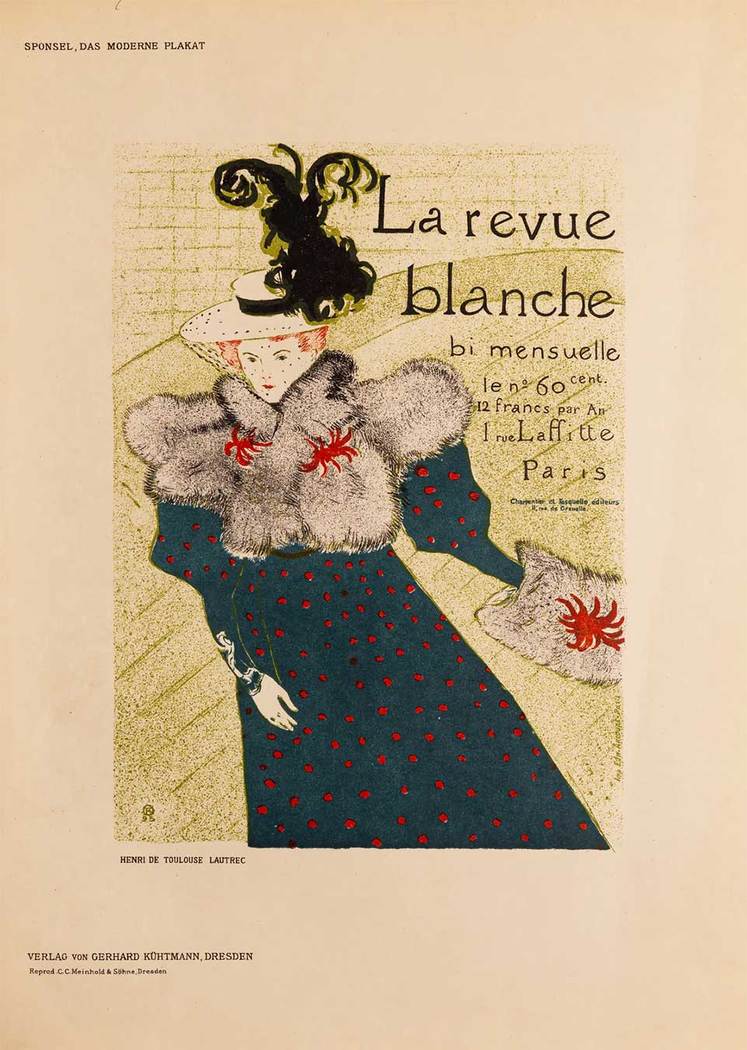
This La Revue Blanche Toulouse-Lautrec poster represents one of the defining images of Henri de Toulouse-Lautrec’s mature poster work and stands among the most celebrated examples of Belle Époque graphic design. The La Revue Blanche Toulouse-Lautrec poster immortalizes Misia Natanson, the central figure of the Parisian avant-garde and wife of magazine editor Thadée Natanson, captured with Lautrec’s characteristic economy of line and restrained color palette.
The composition exemplifies Lautrec’s revolutionary approach to poster design. Rather than elaborate description, the artist reduces the scene to essential forms: a sweeping silhouette of a woman in elegant winter dress, soft tonal contrasts, and deliberately understated environmental cues. The figure’s voluminous fur stole and poised stance convey both elegance and detachment—qualities that would define Parisian sophistication of the era. Contemporary scholarship notes that the image subtly evokes the setting of the Palais de Glace, the fashionable ice-skating venue, without explicitly depicting skates. This economy of suggestion over description became Lautrec’s signature approach and influenced generations of graphic designers.
La Revue Blanche (1889–1903) was the preeminent literary and artistic journal of the Belle Époque, published by Thadée Natanson and featuring the era’s most progressive writers, artists, and critics. The magazine’s visual identity—established through Lautrec’s poster designs—became synonymous with modernist aesthetic innovation. Lautrec’s contributions transformed the poster from a mere announcement into an art object, elevating both his own reputation and the medium itself. The 1895 design remained Lautrec’s most recognizable contribution to the magazine and to poster history. This image has been reproduced in virtually every major survey of Art Nouveau design and poster history.
Misia Natanson (1872–1951) was not merely a society figure but an active patron and muse to the era’s most significant artists. Édouard Vuillard, Pierre Bonnard, and Odilon Redon all depicted her; she became the subject of compositions by Debussy and Satie. In Lautrec’s rendering, her elegance and intellectual presence are distilled into pure form—the silhouette speaks volumes about status, taste, and cultural authority.
This example is identified as a Sponsel edition, representing an authorized printing from the reputable Sponsel publishing house. While not a first-state period impression from the original 1890s production, Sponsel editions were produced with scholarly attention to preserving the original lithographic character and remain recognized within serious collecting circles of Lautrec’s graphic work. The artist’s design integrity remains fully evident; only the impression date differs from period-original examples. Sponsel’s commitment to quality reproduction has made their editions the standard reference for collectors unable to access period-original impressions.
Presented in an acid-free archival folder mounting, suitable for display and preservation. Condition is excellent with no visible wear, tears, or color loss. The tonal subtlety and luminosity essential to appreciating Lautrec’s mastery of the lithographic medium remain fully preserved.
✓ Toulouse-Lautrec authenticated design — identified and documented design attribution
✓ Authorized Sponsel edition — reputable publisher maintaining scholarly reproduction standards
✓ Archival conservation mounting — acid-free presentation and preservation standards
✓ Excellent condition documentation — verified visual integrity without restoration intervention
✓ La Revue Blanche provenance — documented history and cultural significance



Reviews
There are no reviews yet.