
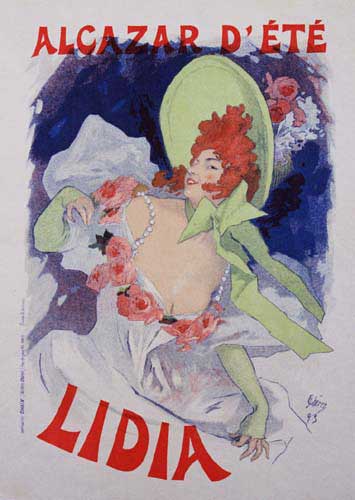
Description
Meet Lidia: The Star of This Extraordinary Poster
This is Lidia—one of Belle Époque Paris’s most celebrated performers. Maître d’Affiche Plate 25 (1896) announces her appearance at the Alcazar d’Ete, a legendary outdoor music hall. Lidia became famous for her “gommeuse” act: a spectacular, double-jointed acrobatic performance that left audiences amazed.
Jules Chéret created this poster, and that’s significant. Chéret didn’t just make advertisements—he transformed commercial poster design into genuine art. As director of the Maîtres de l’Affiche publication series, Chéret chose which artists and designs deserved to be preserved. This plate? It shows you exactly why he’s considered one of history’s greatest poster artists.
What Makes This Design So Captivating
Chéret did something rare here. Instead of showing Lidia’s full body, he painted her in an intimate half-length, focusing on her face, elegant shoulders, and stunning décolletage. This was a bold artistic choice that pulls you directly into her world.
Her expression is playful and inviting. There’s an almost conspiratorial quality, like she’s sharing a secret with you. Above her head sits an elaborate red-plumed hat that crowns the composition with theatrical flair.
Look at those sweeping ribbons. They’re not just decoration—they create movement and rhythm that makes the entire design feel alive and dynamic. Your eye follows them across the poster, and suddenly everything feels energetic and exciting.
The colors are pure Chéret magic: deep navy-blue background, luminous cream skin tones, coral-red accents, and pale chartreuse ribbons that dance across the composition.
Notice how Lidia’s name appears in bold red letters? They echo the pluming above, tying the typography into the visual rhythm. Every element works together. This is mastery.
Why This Moment in History Matters
Music-hall entertainment wasn’t just about fun. It represented modernity and theatrical freedom. Belle Époque audiences craved performances that broke the rules.
Lidia’s specialty was genuinely innovative. Audiences came to see something they’d never seen before. She commanded prestigious venues and attracted crowds hungry for spectacle.
Here’s what’s beautiful: Chéret didn’t trivialize Lidia’s performance. He celebrated it. This poster respects her as an artist. That matters deeply.
Plate 25 in the 256-plate Maître d’Affiche series (1895–1900) carries real institutional weight. Each plate represents Chéret’s personal curatorial judgment about what deserved preservation as art. This poster documents something genuinely important: how Belle Époque society valued female performers, their skill, and their right to command prestigious stages.
Your Piece of Art History
This original chromolithograph has aged beautifully. The navy background maintains its deep, rich saturation. The flesh tones retain their creamy glow. The red pluming shows no fading.
It’s been professionally conserved with museum-standard linen backing and mounted in acid-free matting. That means this poster will survive for future generations.
As an original stone lithograph from 1896, this represents a museum-quality example of both Chéret’s genius and Belle Époque theatrical culture at its height. You’re not just acquiring a decorative object—you’re preserving a document of artistic innovation and performer celebrity from one of history’s most exciting eras.




Reviews
There are no reviews yet.