
Description
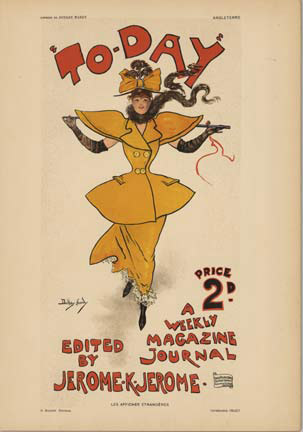
Dudley Hardy’s Weekly Magazine Journal poster exemplifies the revolutionary moment when English poster design embraced the chromatic exuberance and figural vitality that Jules Chéret had pioneered in Paris. Created in 1897 for the prestigious Les Affiches Étrangères Illustrées series, this work showcases Hardy’s distinctive ability to distill theatrical glamour into pure visual rhythm—a female figure rendered in luminous golden tones, her body twisted into an elegant arabesque that reads as both fashion silhouette and kinetic performance. The typography, boldly integrated into the composition rather than merely appended, announces the publication with the confidence of an artist who understood that English Art Nouveau poster design required its own visual dialect. Where Chéret’s compositions celebrate opulent sensuality, Hardy’s approach is more angular, more deliberately constructed—the figure’s exaggerated proportions and the sharp interplay between warm golds and cooler backgrounds create an aesthetic tension that feels distinctly British in its wit and sophistication. This is the work of an artist who had absorbed the lessons of Continental modernism while forging a personal visual language.
The chromolithographic execution, handled by the legendary CHAIX workshop in Paris, demonstrates why Hardy’s reputation as a master of color lithography remains justified more than a century later. The golden dress, rendered through multiple stone plates with extraordinary subtlety, shifts in tone from warm ochre to deeper amber, creating the illusion of sculptural form and luminous surface simultaneously. The flesh tones of the figure possess an almost porcelain quality—delicate yet assertive—while the background plays soft greens and dusty rose against the dominant warmth of the central figure. The fine vellum paper, preserved in archival conservation mounting and linen backing, has retained both the chromatic intensity and the subtle tactile quality that distinguishes hand-pulled chromolithography from mechanical reproduction. This is authentic vintage English poster art from the height of the Belle Époque, a work that shaped how British audiences understood modernist design and commercial visual culture.
What positions Hardy within the pantheon of turn-of-the-century poster masters is his sophisticated understanding of the relationship between figuration and commercial purpose. The 2d price mark, prominently displayed, transforms this piece from pure decoration into functional advertising—yet the artistic ambition never yields to commercial necessity. Instead, the two imperatives merge seamlessly. For collectors seeking original English Art Nouveau poster art or those drawn to vintage magazine cover design from the 1890s, Hardy’s work occupies a unique position: it celebrates the aesthetic innovation of Continental modernism while maintaining distinctly English formal and compositional values. The recurring subjects that defined Hardy’s oeuvre—the dancer’s leg, the theatrical costume, the fashionable silhouette—appear here not as repetitive formula but as essential elements of a coherent artistic vision exploring the intersections of fashion, performance, and modernity.
Numbered 281 from the 1,050-copy edition printed on fine vellum in 1897, this original chromolithograph has survived in very good condition—a testament to both the durability of period materials and the care it has received. The dimensions (8.625″ × 12.375″) are characteristic of the Les Affiches Étrangères format, yet this poster’s visual presence transcends its modest scale. As an IVPDA-authenticated original (not a reproduction), professionally conserved and linen-backed for preservation, Weekly Magazine Journal carries both historical significance and substantial aesthetic authority for serious collectors. Whether you’re drawn to Hardy’s mastery of English Art Nouveau design, the technical perfection of period chromolithography, or the enduring appeal of vintage magazine and entertainment poster art, this piece represents a rare window into the moment when British poster design embraced modernist innovation while maintaining its own artistic identity. An exceptional acquisition for discerning collectors of collectible chromolithograph posters and 1890s periodical advertising art.




Reviews
There are no reviews yet.