

Description
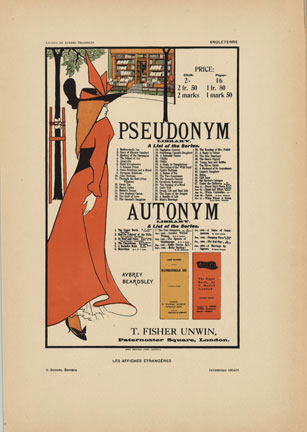
Here’s where the controversy starts: Aubrey Beardsley designed this to advertise children’s books, and Victorian society absolutely lost its mind. Look at what he chose for the composition—a woman’s silhouette in bold black and cream, with cleavage that shocks even by modern standards. That wasn’t an accident. This was Beardsley’s radical refusal to sanitize the marketing of children’s literature. While other designers played it safe, he understood that design excellence transcends the category it serves. The publisher, T. Fisher Unwin of London, trusted him completely. That’s institutional confidence in an artist’s vision.
What you’re acquiring is actually the rare version with integrated advertising text. The original existed as a striking graphic on the left side only—the right half deliberately blank for booksellers to add their own information. This shows Unwin’s full publication catalog: St. Nicholas for Young Folks, The Land of Pluck, Topsys and Turvys, complete with author credits and period pricing (Palmer Cox titles at 6 shillings cloth, 3/6 paper). It’s a working advertisement, not merely decoration. Every element serves a commercial purpose without sacrificing artistic integrity.
The scale of this commission reveals where Beardsley stood in 1897. Chaix, the legendary Paris lithography house, and G. Boudet, editor of Les Affiches Étrangères Illustrées, selected Beardsley as one of their most prestigious foreign contributions. Of the 1,025 copies printed on fine vellum, this piece came from the justified limited run. They weren’t celebrating tame design. They were celebrating fearlessness. The selection proves that Belle Époque institutions recognized radical modernism as the surest marker of commercial authority.
The scandal it provoked is where authenticity lives. Newspapers complained. Critics called it inappropriate for children’s literature. But the design persisted, was collected, appeared in Maître d’Affiche circles, and became canonical. That’s how you know an image has real power—it offends, it persists, and it transforms how we see the world. Holding this poster means holding a moment when serious design institutions chose courage over convention.



,%20Les%20Affiches%20Étrangères%20Illustrées,%201897%20|%20Radical%20Art%20Nouveau%20Modernism&url=https://www.thevintageposters.net/product/aubrey-beardsley-publisher-childrens-books-poster-1897/&media=https://www.thevintageposters.net/wp-content/uploads/2025/12/LAE0003.jpg)
Reviews
There are no reviews yet.