
Description
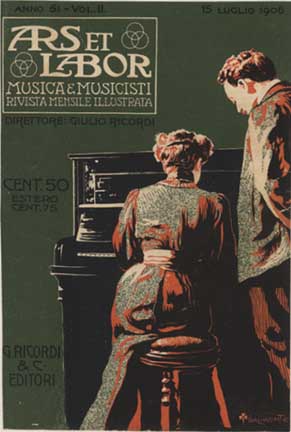
The intimate warmth of this Ars et Labor magazine cover captures a quintessential moment of early 20th-century domestic refinement—a woman in an elaborately patterned Victorian dress seated before a grand piano, her posture graceful and composed, while a gentleman stands behind her, leaning in with rapt attention to her playing. The artist has orchestrated a masterclass in atmospheric color: a cool olive-green background bleeds into the shadowed folds of the figures’ clothing, while warm oranges and burnt sienna tones illuminate the fabrics and skin, creating the unmistakable impression of candlelight—intimate, flickering, alive. The interplay of warm and cool tones transforms what might be a simple domestic scene into something deeply romantic and aspirational, speaking to the era’s idealization of cultured leisure and artistic partnership.
Ars et Labor was the monthly Italian journal dedicated to music and musicians, circulating among educated middle and upper-class readers who valued both performance and the social rituals surrounding it. This cover image—rendered in the refined chromolithographic technique—served as a visual gateway to that world of refinement, promising readers insight into the lives and work of accomplished musicians. The composition’s elegance and the technical precision of the color registration underscore the publisher’s commitment to quality and cultural aspiration.
Condition & Details
Linen-backed original in fine condition. The colors remain vibrant; the olive-green background and warm ochres and oranges retain their depth and luminosity. The paper shows minimal age-wear. The linen backing is secure and supportive.
Size: 6.25″ × 9.125″
Medium: Lithograph
Date: 1906
Inventory #: 7539
Certificate of Authenticity: Included
About the Piece
This cover exemplifies the sophistication of early 1900s Italian commercial art and magazine design. The restraint of the color palette—limited primarily to olive, warm earth tones, and black—demonstrates the lithographer’s mastery of chromatic harmony. The psychological depth of the scene—the gentleman’s studious gaze, the woman’s absorbed concentration—elevates this from mere illustration to intimate portraiture, a snapshot of cultural life at a moment when music, education, and domestic refinement were central to middle-class identity.
For collectors of European magazine graphics, Italian publishing design, and works capturing the aesthetic sensibility of the Belle Époque, this cover represents an authentic artifact of its cultural moment.

&url=https://www.thevintageposters.net/product/ars-et-labor-piano-musica-musicisti/&media=https://www.thevintageposters.net/wp-content/uploads/2025/12/7539.jpg)
Reviews
There are no reviews yet.