
Description
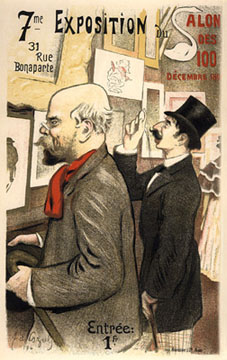
This poster captures a pivotal moment in art history—the exact instant when the poster itself became worthy of exhibition and serious artistic consideration. The Salon des Cent, housed on Rue Bonaparte under the vision of La Plume magazine’s editor Léon Descamps, was revolutionary: it treated posters not as throwaway commercial ephemera but as legitimate fine art deserving wall space, critical attention, and preservation. This 1896 design documents that transformation perfectly.
The composition speaks volumes about the Salon’s cultural mission. We see two towering figures of French literary and artistic life—the symbolist poet Paul Verlaine, identifiable by his distinctive silhouette and black hat, and Jean Moreas, founder of the Ecole Romane—pausing to examine works on the gallery wall. One of the pieces they’re studying is actually a Jossot design for an earlier Salon des Cent exhibition that same year. It’s poster art celebrating poster art, a self-referential wink that speaks to the Salon’s bold new aesthetic authority.
Between 1894 and 1900, the Salon des Cent organized 43 exhibitions, with 40 different artists designing posters for them. This was no small operation—it was a deliberate, sustained effort to elevate the poster medium and connect it directly to Paris’s literary and artistic elite. Descamps championed reproduction in La Plume, organized thematic shows, and made posters accessible to the public. He understood something crucial: the poster was the democratic art form of the Belle Époque, and it deserved serious curatorial attention.
As an original Les Maîtres de l’Affiche Plate 15 from 1896, this lithograph is both a documentary and an artistic masterpiece. It preserves the Salon’s vision while embodying the finest technical standards of Imprimerie Chaix. For collectors, it represents a rare intersection of literary history, artistic innovation, and cultural significance—a window into the exact moment when Paris recognized the poster’s power.



Reviews
There are no reviews yet.