
Description
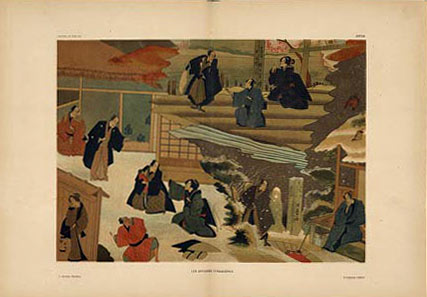
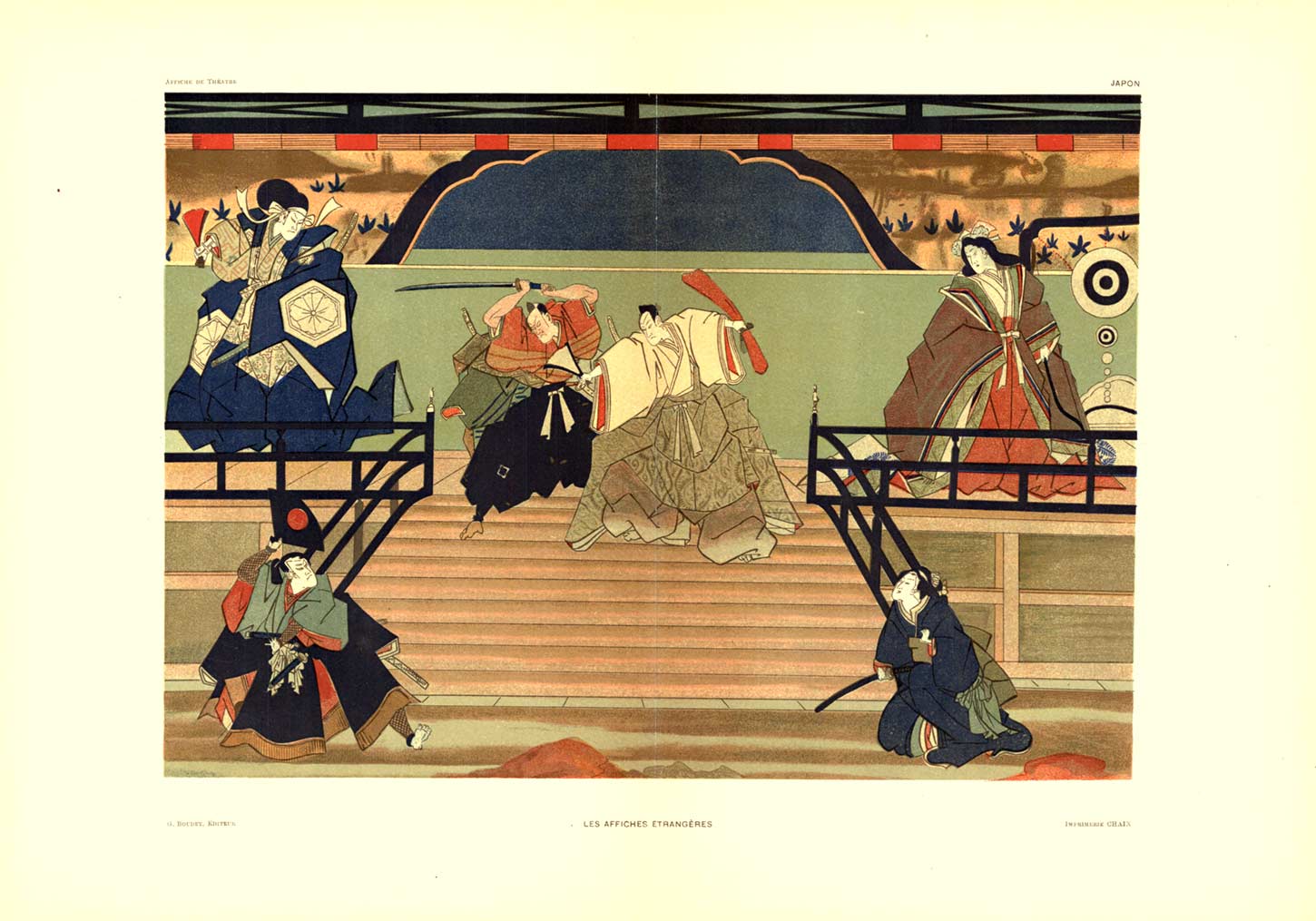
Look at this Kabuki Theater Scene and you’re witnessing a pivotal moment in European aesthetic consciousness. Utagawa Yoshiiku, master of Meiji-era Japanese woodblock art, created one of the most extraordinary theatrical compositions of the 19th century—a kabuki stage alive with actors, gesture, and dramatic intensity. When Chaix and G. Boudet selected this Kabuki Theater Scene for Les Affiches Étrangères Illustrées in 1897, they were making an institutional declaration: Japanese theatrical mastery deserves equal standing with European fine art. This wasn’t cultural tourism or exotic decoration. This was curation at the highest level—recognizing that Yoshiiku’s Kabuki Theater Scene embodied artistic sophistication that transcended geography and tradition.
Notice how Yoshiiku composes the Kabuki Theater Scene with layered spatial depth—multiple actors positioned across the stage at different planes, their silhouettes creating rhythmic movement even in stillness. The traditional kabuki costumes, the dramatic gestures, the architectural framing of the theatrical space—every element reveals an artist who understood how to translate three-dimensional performance into two-dimensional composition. The vellum paper stock that Chaix selected for this Kabuki Theater Scene reproduction honors the original woodblock’s delicacy. This wasn’t mass production. European collectors received the Kabuki Theater Scene as institutional endorsement: this image matters as much as any European salon painter’s work.
What makes this particular Kabuki Theater Scene extraordinary is its historical moment. Yoshiiku was documenting kabuki tradition at the precise inflection point when Meiji modernization threatened to erase it. His theatrical compositions became historical records—proof that Japanese artistic mastery had depth, philosophy, and generational refinement. When European institutions like Chaix and Boudet reproduced the Kabuki Theater Scene as a stone-lithograph, they were making an argument about cultural equality. The composition, the technical mastery, the theatrical understanding—these belonged in conversation with European art, not relegated to decorative periphery.
You’re acquiring a bridge between two artistic traditions at the moment European institutions finally recognized Japanese theatrical genius. This Kabuki Theater Scene arrived in European collections because Utagawa Yoshiiku proved that kabuki wasn’t exotic performance—it was fine art. Published in the limited edition of 1,025 copies (copies 281–1,050) of Les Affiches Étrangères Illustrées, this stone-lithograph remains a testament to how Belle Époque curators understood prestige. Chaix printing, Boudet’s vision, and Yoshiiku’s Kabuki Theater Scene created a moment when European institutions finally positioned Japanese artistic mastery as equal to their own. That institutional courage changed how the world understood theater, composition, and cultural authority.



Reviews
There are no reviews yet.