
Description
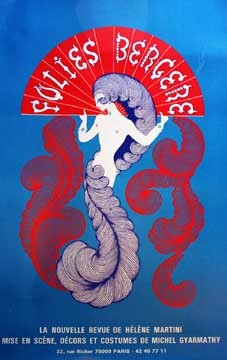
There’s a particular kind of confidence that comes with creating a poster for a legend—and Erté, even in 1982, radiated exactly that. He’d spent decades defining what theatrical glamour could look like, and this poster distills everything he’d learned into a single, unforgettable image. A dancer emerges from that brilliant blue as if the color itself had conjured her. Feathers cascade down her body like liquid silk. The red fan becomes both object and statement. This is theater as pure visual seduction.
What makes this image so magnetic is the restraint beneath the opulence. Erté could have overwhelmed the composition—filled it with detail, texture, complexity. Instead, he trusts the silhouette. That dancer’s body becomes the architecture. The feathers aren’t decoration; they’re form. The fan is architectural. Every line serves the whole. This is the work of an artist who understood that true luxury is knowing what to leave out.
Hélène Martini—the Empress of the Night—brought her own legend to this production. She’d managed the Folies Bergère from 1974 to 2000, shepherding the venue through decades of change while maintaining its essential character. A showgirl who became an institution. Michel Gyarmathy’s costumes and set design shared that same philosophy: audacity tempered by elegance, spectacle grounded in artistry. This poster announces that vision: the Folies Bergère wasn’t resting on its Belle Époque laurels. It was still evolving.
The beauty of a 1982 Erté poster is that it occupies a specific historical moment. Erté was in his nineties, at the end of a career that stretched back to the Russian avant-garde, through the Art Deco explosion, through decades of Hollywood design. This poster isn’t nostalgia for what the Folies Bergère was. It’s a statement about what it remained: a place where visual imagination still mattered, where artistry and entertainment weren’t separate things but expressions of the same impulse.
The color work is stunning—that electric blue, those rich reds, the precision of the typography. This is a first printing, which means you’re looking at the original lithographic registration, the exact color separations Erté approved. There’s an immediacy to first printings that later reproductions can’t quite match. The poster hasn’t been reissued or softened. It’s the version that actually hung in Paris in 1982, advertising a revue that mattered.
For collectors, an original Erté poster from this period occupies a curious place: it’s recent enough to feel contemporary, old enough to feel historical, and created by an artist whose entire career was spent at the intersection of fine art and theatrical design. This isn’t a reproduction. This is a document of a specific moment when one of the 20th century’s great designers was still creating for one of the world’s most storied cabaret venues.
Erté’s late masterpiece: feathers, fans, and the blue infinity of theatrical desire captured in 1982.




Reviews
There are no reviews yet.