
Description
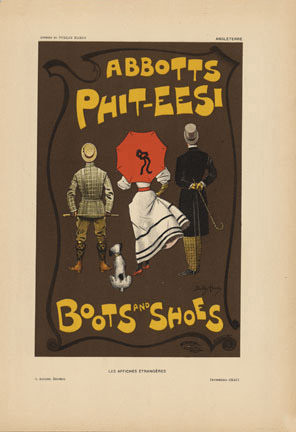
Dudley Hardy’s Abbotts Phit-Eesi poster exemplifies the commercial mastery that made him England’s preeminent fashion and product advertising artist during the Art Nouveau era. Created in 1897 for the prestigious Les Affiches Étrangères Illustrées series, this work transforms the prosaic subject of boots and shoes into pure visual spectacle through Hardy’s signature deployment of elegant figuration, sophisticated color harmony, and ornamental vitality. Three fashionably dressed figures—rendered in carefully modulated flesh tones and period costume—command the composition with the confidence of models presenting the season’s essential accessory. The central female figure, her body twisted into an elegant contrapposto stance that recalls classical sculpture yet feels entirely modern, dominates through both scale and chromatic presence. Against a rich dark brown ground punctuated by ornamental flourishes, the figures emerge with sculptural clarity while the golden typography—”ABBOTTS PHIT-EESI” and “BOOTS & SHOES”—assertively announces the product name with commercial directness. This is Art Nouveau commercial design at its finest: advertising that never sacrifices artistic ambition for sales effectiveness.
The chromolithographic execution, handled by the legendary Jules Chéret workshop in Paris, demonstrates why Hardy’s commercial work commands the same respect as purely decorative Art Nouveau posters. The rendering of fabric—the patterns of the figures’ garments are suggested through subtle color modulation and linear detail rather than literal reproduction—shows technical sophistication that elevates this from mere product advertisement into genuine visual art. The flesh tones possess extraordinary subtlety, shifting from warm ochre in highlighted areas to cooler, more muted tones in shadow, creating the illusion of three-dimensional form and atmospheric depth. The dark brown ground, rendered with chromatic richness and complexity, recedes appropriately to allow the figures to advance toward the viewer. Printed on fine vellum paper and preserved in archival conservation mounting, this poster retains both the chromatic intensity and tactile quality that distinguish hand-pulled chromolithography from mechanical reproduction. This is authentic English commercial poster art from the height of the Belle Époque, a work that shaped how consumers understood modernist design applied to everyday products.
What distinguishes Hardy’s approach to Art Nouveau product advertising is his understanding that selling fashion accessories required celebrating not the product itself but the lifestyle and social aspiration it embodied. The boots and shoes remain largely invisible in this composition; instead, Hardy presents the beautifully dressed figures who wear them, implying that Abbotts Phit-Eesi footwear enables and completes fashionable identity. This sophisticated commercial psychology—never didactic or heavy-handed—elevates the poster beyond ordinary advertising into the realm of aspirational visual culture. For collectors seeking original English Art Nouveau poster art or those drawn to vintage fashion and footwear advertising, this piece occupies a unique position: it demonstrates how artistic ambition and commercial effectiveness merge seamlessly in the hands of a master designer. The poster also carries historical interest for those studying 1890s fashion, footwear design, and consumer culture, as it documents the visual language through which period consumers understood style, elegance, and modernity. Hardy’s Abbotts Phit-Eesi becomes a window into both artistic innovation and the commercial structures that made that innovation economically viable.
Numbered 281 from the 1,050-copy edition printed on fine vellum in 1897, this original chromolithograph survives in excellent condition—a remarkable achievement for a commercial poster now over 125 years old. As an IVPDA-authenticated original (not reproduction), professionally conserved and ready to frame, Abbotts Phit-Eesi carries both historical significance and substantial aesthetic authority for serious collectors. Whether you’re drawn to Hardy’s mastery of English Art Nouveau design, the technical perfection of period chromolithography, the history of vintage fashion advertising, or the enduring appeal of Art Nouveau commercial poster art, this piece represents a rare convergence of artistic excellence and commercial purpose. The fact that this poster was also issued as a Maître d’Affiche (a larger format variant for serious collectors) speaks to the commercial and artistic success it achieved during its own era—a validation that resonates across generations for discerning collectors of collectible chromolithograph posters and 1890s advertising design.




Reviews
There are no reviews yet.