
Description
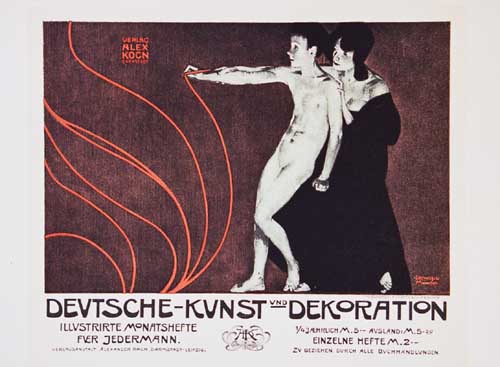
Josef Rudolf Witzel’s Deutsche Kunst und Dekoration poster stands as a defining moment in early modernist design—Maître d’Affiche Plate 164 (1899), Imprimerie Chaix, Paris, published under the curatorial direction of Jules Chéret. Witzel (1867–1924), an Austrian-German designer whose practice bridged the innovation of the Vienna Secession and the sophistication of French Art Nouveau, created this composition as both a magazine advertisement and an artistic manifesto. The poster announces a publication dedicated to celebrating European decorative arts at the precise inflection point where Art Nouveau’s organic expressionism transitioned toward Secession’s geometric refinement. Witzel’s positioning within the Maître d’Affiche collection (96 international artists across 256 plates, 1895–1900) authenticates his role in this continental modernist discourse—not as a French provincial decorator, but as a Central European modernist strategist.
The compositional mastery demonstrates Witzel’s technical command of chromolithographic sophistication. Two elegantly stylized figures—rendered in luminous cream and white against a deep burgundy ground—execute a dynamic gestural movement, their bodies forming an arc of modernist grace. The decorative line-work radiating from the composition’s left edge (executed in burnt orange and copper tones) creates rhythmic visual momentum, a signature Witzel technique that anticipates Secession geometric abstraction. Typography integrates seamlessly into the decorative field: “DEUTSCHE-KUNST**DEKORATION” positioned horizontally across the lower register in authoritative serif capitals, grounding the ethereal figuration with commercial necessity. The color palette—deep burgundy, cream, white, burnt orange—establishes chromatic authority without ornamentation excess, a restraint that distinguishes Witzel’s modernist sophistication from earlier Art Nouveau exuberance. The poster demonstrates that commercial design and artistic innovation operate as unified disciplines, not hierarchical opposites.
Deutsche Kunst und Dekoration magazine (founded 1897, published from Darmstadt) championed Art Nouveau’s evolution into modernist design systems—a cultural position precisely aligned with Maître d’Affiche’s institutional mission under Chéret’s direction. This poster authenticated the magazine’s prestige as a European design authority, positioned against French decorative dominance. The composition captures a transitional cultural moment: 1899 represented the final year before Art Nouveau’s aesthetic exhaustion and the emergence of Secession severity. Witzel’s design—neither purely organic nor strictly geometric—documents this aesthetic negotiation visually. The poster’s subject matter (promotion of design magazine celebrating artistic innovation) creates meta-commentary on poster art itself as democratic modernism: the finest aesthetic principles democratized through commercial distribution. This positioning elevated both the magazine’s authority and the Maître d’Affiche publication’s continental reach.
The museum assessment confirms Plate 164’s institutional significance within the 256-plate series (1895–1900, spanning 97 international artists). Witzel’s inclusion reflects Chéret’s curatorial commitment to recognizing Central European modernism alongside French Art Nouveau dominance—a positioning that establishes scholarly authority for museum collections documenting the geographic complexity of design history. The original lithograph demonstrates chromolithographic color integrity across all registers: the burgundy ground maintains saturation without fading, the cream figures retain luminosity, and the decorative line work preserves copper-tone definition. Conservation standards require acid-free archival mounting and climate-controlled storage to preserve the paper support and the stability of chromolithographic ink. The 15.75″ × 11.25″ format aligns with standard Maître d’Affiche dimensions, facilitating authentication through physical specifications. Professional condition assessment (linen-backed, conservation-mounted, excellent condition documentation) establishes provenance transparency and collector confidence in museum-quality preservation standards.




Reviews
There are no reviews yet.