

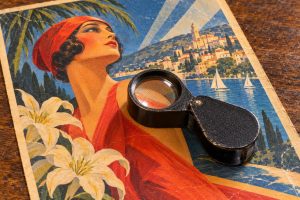
Quick Answer: Original vintage posters are stone lithographs on aged paper, with printer marks and odd historical sizes. Reproductions are modern offset prints with CMYK dots on bright white stock in standard sizes.
Original stone lithograph = flat solid color, no dots. Modern offset reproduction = tiny rosette CMYK dots under 10x loupe. If you see dots, it’s not an original from 1890-1930s.
Originals are on heavy rag / wove paper, often with slight patina, foxing, or deckle. Reproductions are on bright white, thin, perfectly smooth modern stock. Back should look aged, not printer-fresh.
Originals have odd historic sizes – e.g. French Grande 47×63″, Panneau 37×62″. Reproductions are almost always 24×36″, 18×24″, A2. If it fits a cheap IKEA frame perfectly, be suspicious.
Look in the bottom margin for Imp. Chaix, Mourlot, Cassandre, Bedos, Affiches Gauloises etc. No printer/publisher + no artist signature in-plate = red flag.
Old posters were folded for mailing or posted on walls — you should see horizontal/vertical fold lines, pinholes in corners, glue residue, linen texture if backed. Perfectly flat, stark-white back = reprint.
Shine UV/blacklight in a dark room. Modern paper with optical brighteners glows bright blue-white. 100-year-old paper stays dull/yellow. Quick dealer trick.
Ask: Where did it come from? Do you provide a certificate + condition report? If a $15,000 Mucha is listed for $199, unbacked, unframed, with free shipping, it’s a decor copy. Real dealers – like you, an IVPDA member since 1998 – document it.