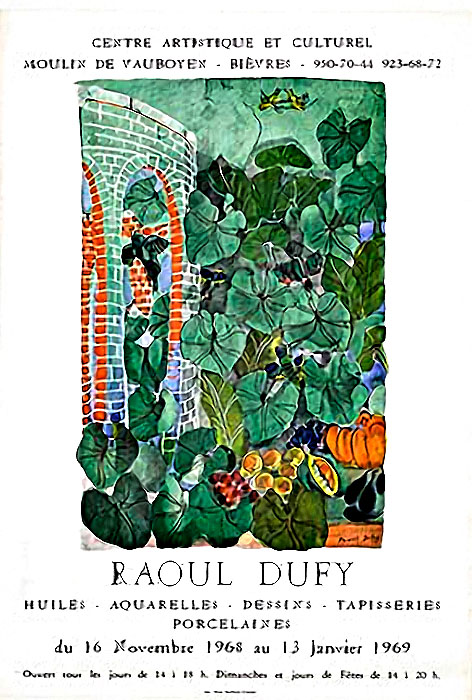
Raoul Dufy
Raoul Dufy (3 June 1877 – 23 March 1953)
French painter, draftsman, printmaker, illustrator, and textile designer, and one of the leading colorists of the 20th century 10. He was born in Le Havre, Normandy, and died in Forcalquier, in 1953 7.
Early training. Born into a modest family (his father an accountant, later a bookkeeper for a metallurgy company), Dufy took evening classes at the École des Beaux-Arts in Le Havre while working as an apprentice at a coffee-importing firm — where a fellow employee was Othon Friesz, who became a lifelong friend 7. In 1900 he moved to Paris, studying at the École Nationale Supérieure des Beaux-Arts under Léon Bonnat, and shared lodgings with Friesz while they painted together 7. He was initially influenced by Impressionism, especially the work of Claude Monet and Camille Pissarro 7
Fauvism and after. Dufy’s discovery of Fauvism — seeing Matisse’s Luxe, Calme et Volupté at the 1905 Salon — was a revelation that freed his color and line from serving merely to describe subjects 1. He exhibited in the 1907 Salon des Indépendants as a Fauve 7. He subsequently moved through a brief Cézanne-inspired period and then, around 1909, worked closely with Georges Braque during a stay at L’Estaque, absorbing Cubism‘s fractured structure 27.
The signature style. Dufy’s mature manner is instantly recognizable: a distinctive decorative, colorful style that fuses the vivid, expressive attributes of Fauvism with the foreshortened perspectives of Cubism, using a “stenographic” technique — rapid, light contour drawings filled with broad, bright washes of color, usually applied over a white ground 21. Common subjects were leisure and joy: racetracks, regattas, seaside scenes, orchestras, and elegant society 8.
Textiles, fashion, and design. Dufy is unusual among his peers for a major parallel career in the applied arts. Around 1912–1930 he was a designer for the celebrated couturier Paul Poiret, and designed fabric for the silk firm Bianchini-Férier in Lyon 64. His colorful, decorative sensibility also extended to ceramics, tapestries, and furniture, and the style became highly fashionable for such designs 45.
Showing all 2 results