Percy Trompf
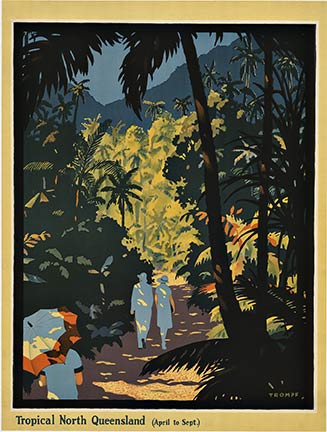
Percy Trompf (1902–1964) was an Australian commercial artist and one of the nation’s most celebrated poster designers, renowned for his bold Art Deco travel posters and advertising designs that shaped early mid-century Australian tourism marketing. Born in Beaufort, Victoria, Trompf trained at the Ballarat School of Mines and emerged as a master of colour lithography, creating thousands of distinctive commercial designs for Australia’s tourism boards, railways, and international corporations.
Trompf began his professional career in 1923 designing confectionery packaging for Melbourne commercial studios before establishing his own practice on Little Collins Street. His breakthrough came through partnerships with the Victorian Railways Betterment and Publicity Board and the Australian National Travel Association (ANTA), for whom he produced hundreds of travel posters promoting domestic destinations. His Art Deco style—characterized by simplified realism, bold flat color fields, and dynamic composition—proved especially powerful during the Great Depression, encouraging Australians to travel by rail, visit natural attractions, and embrace leisure activities including sun-worship, surfing, and bushwalking. His poster designs for the Great Barrier Reef (1933), Sydney Harbor Bridge, and Captain Cook’s Botany Bay landing became iconic representations of Australian identity and destinations. During World War II, Trompf served as a camouflage officer in the Royal Australian Air Force (1942–1948), later returning to commercial design work for the Queensland Government Tourist Bureau and Commonwealth Railways. His postwar output declined as photography increasingly replaced hand-drawn illustration in tourism marketing.
Trompf’s market significance has grown substantially since his death. Collectors and museums now regard his posters as historical treasures documenting mid-century visual culture and tourism branding in Australia. His work appears in major institutional collections including the National Library of Australia, National Gallery of Victoria, Art Gallery of New South Wales, and the Australian National Museum. Auction records demonstrate consistent collector demand: his original lithographs regularly fetch between $2,000 and $12,000 USD at international sales. The investment appeal of Percy Trompf posters reflects their rarity (many print runs are no longer documented), museum-quality craftsmanship in colour lithography, and growing recognition among design historians as pioneering examples of “country branding”—visual strategies that shaped how nations marketed themselves to international travelers. Museums continue to acquire and exhibit his work, cementing his reputation as Australia’s defining travel poster artist.
Showing the single result