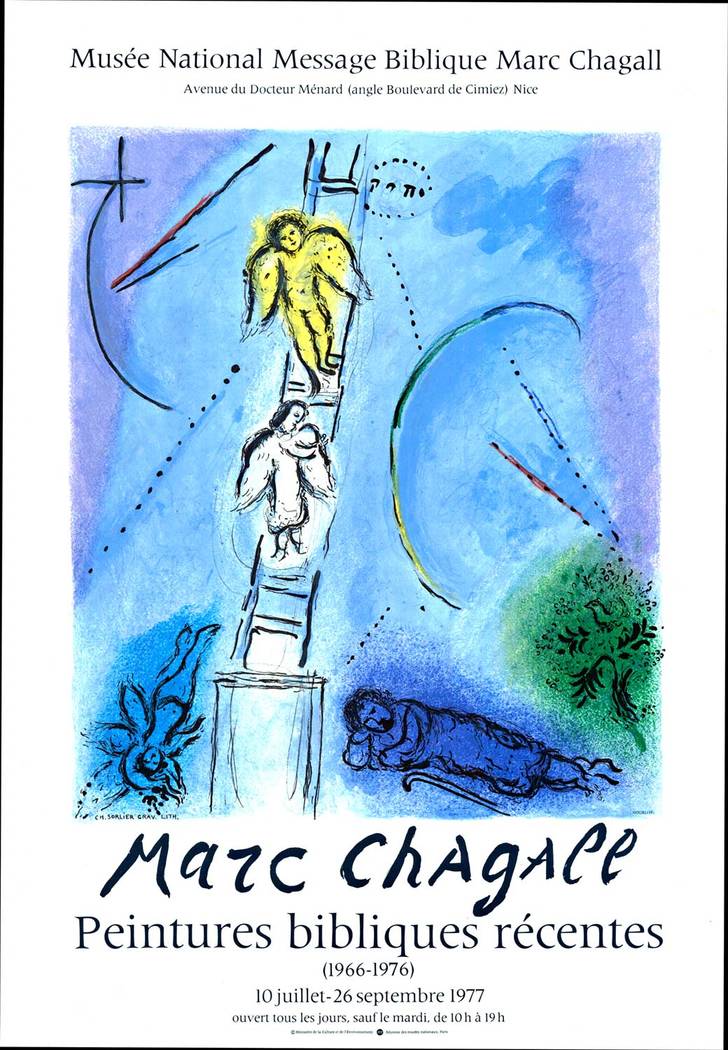
Marc Chagall
Marc Chagall
Marc Chagall was a Belarusian-French modernist painter, illustrator, and printmaker who became one of the twentieth century’s most celebrated and versatile artists. Born in Vitebsk and establishing his career in Paris, Chagall developed a distinctive visual language that merged Cubist abstraction, Surrealist dreamscapes, and deeply personal Jewish and Russian cultural symbolism. His work spans painting, printmaking, stained glass, and applied arts, establishing him as a towering figure in modern art whose influence extended across multiple aesthetic movements and media.
Chagall’s poster and graphic work—created throughout his career from the 1910s onward—demonstrates his mastery of color, composition, and narrative imagery. His designs for theatrical productions, exhibitions, cultural institutions, and commemorative projects showcase his ability to translate his mystical, poetic vision into powerful public imagery. His prints and lithographs, in particular, reveal his sophisticated understanding of printmaking techniques and his commitment to making fine art accessible through multiple mediums. Chagall’s graphic work combines modernist formal innovation with deeply humanistic content, creating images that resonate across cultures and generations.
Collectors and institutions value Marc Chagall posters and prints as significant works of modernist art history and graphic design. His pieces represent the synthesis of avant-garde aesthetics with accessible, emotionally resonant imagery—bridging gallery art and commercial application. Original Chagall lithographs, exhibition posters, and graphic works command strong collector and institutional demand for their artistic importance, technical mastery, and enduring cultural significance as exemplars of twentieth-century modernism and humanistic visual expression.
Showing the single result