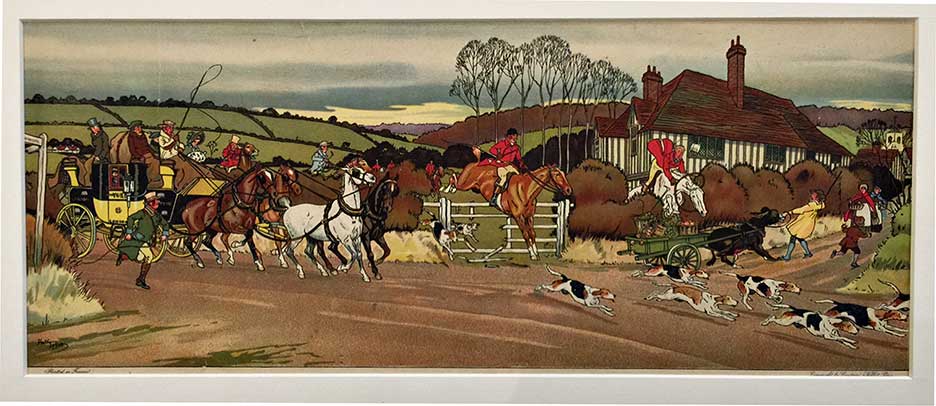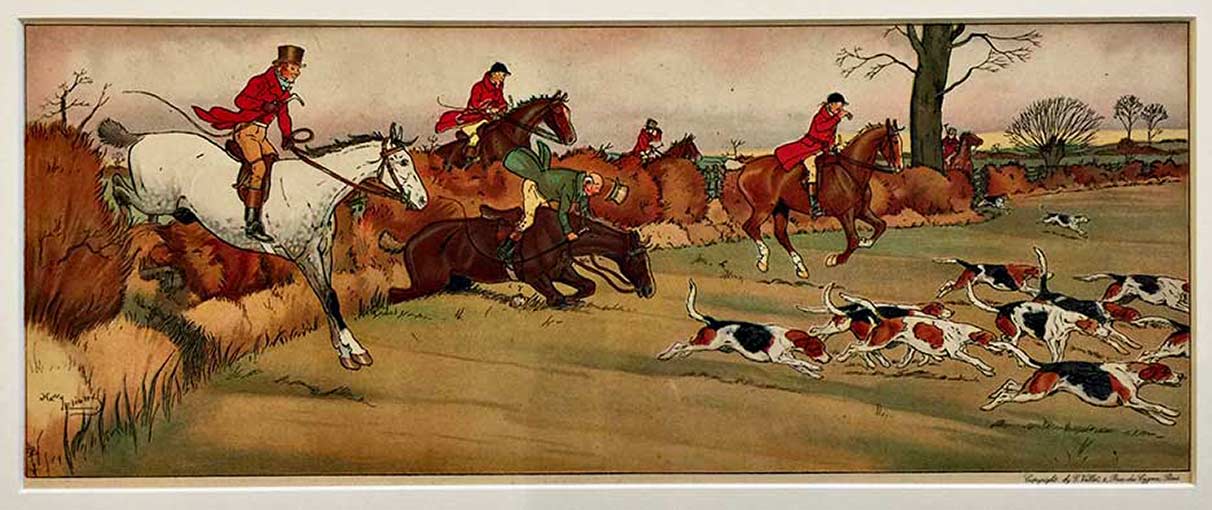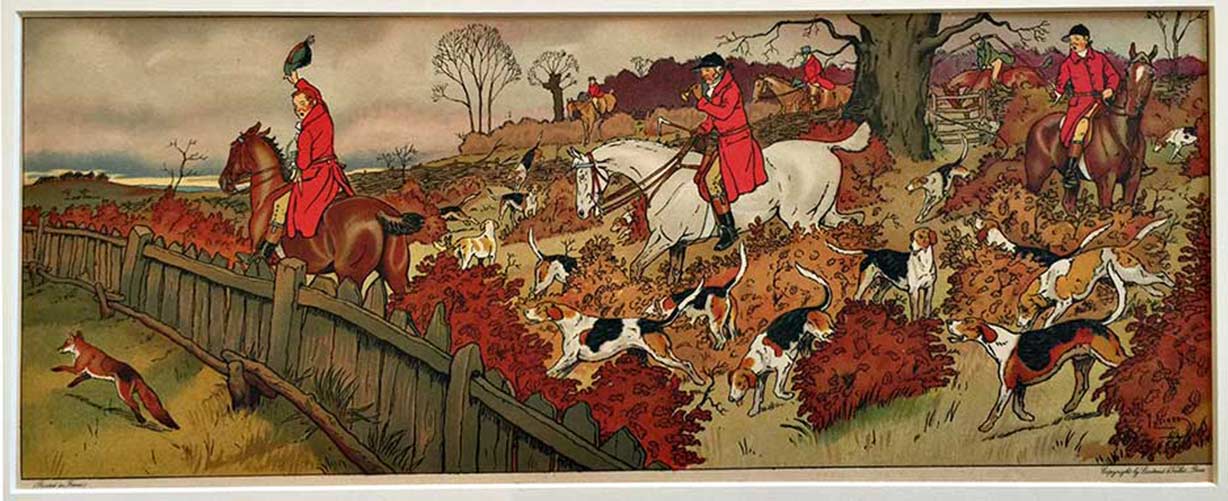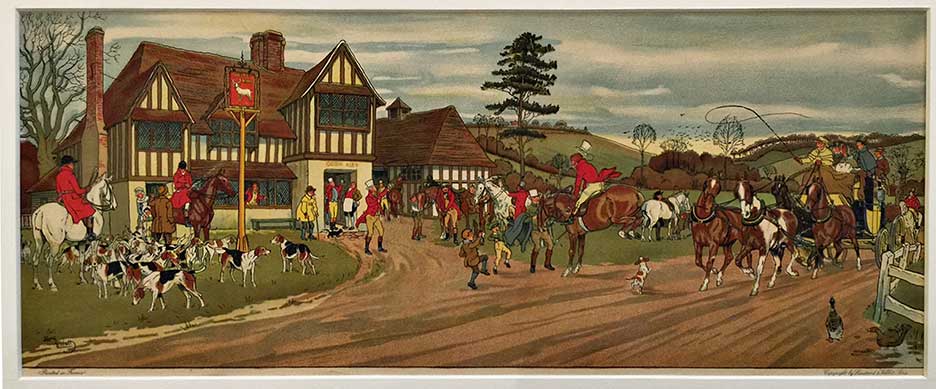
Harry Eliott Lieutard Vallet
Harry Eliott (1882–1959) — born Charles Edmond Hermet in Paris on 14 June 1882, died at Villez-sous-Bailleul (Eure) on 25 May 1959 3.
The name(s). “Harry Eliott” was a deliberate Anglo-Saxon pseudonym, not a birth name. The son of a lithographic printer and an England-lover, he adopted the English-sounding pen name early and even tried to pass himself off as English — a marketing move that opened doors to the British art market and the Victorian sporting aesthetic he admired 31. Note that “Harry Eliott Lieutard Vallet” is the composite label some poster dealers use (e.g., The Vintage Poster) — it conflates his pseudonym with associated catalog names, and it is not his legal name. His legal name was Charles Edmond Hermet 63. Worth flagging for your listing: if your poster is signed in the plate, the signature will read “Harry Eliott,” not “Lieutard Vallet.”
Artistic identity. He was a French draftsman, illustrator, and watercolorist best known for humorous, hand-colored lithographs and pochoir/stencil prints in the Victorian style of English illustrators he admired — Randolph Caldecott and especially Cecil Aldin 31. His subjects were the sporting life: fox hunting and the running of hounds, horse-drawn and early motor cars, gentlemen drivers, monks, and similar turn-of-the-century vignettes 16. His etchings and the postcards drawn from them were published by Barré and Dayez 31. He also produced lithographs of early automobile racing — for example, a 1908 hand-colored print of Baron de Crawhez’s Panhard et Levassor at Paris–Madrid 6.
Career beyond prints. He illustrated children’s and youth books, notably for Hachette in the Bibliothèque verte and Bibliothèque de la jeunesse series — Dickens’ David Copperfield and The Pickwick Papers, Jack London’s White Fang, and Curwood’s Bari chien loup and Kazan 3. He illustrated magazines (Nos loisirs, Mon journal illustré, Le Sourire, La Revue Illustrée) and, from 1923 to 1940, catalogues for Manufrance, plus several covers of Le Chasseur français 3.
Life. Mobilized in 1914, he married a Norman woman in 1915 and settled in Normandy after being invalided out for depression in 1917; the couple spent time in England 3. His sister Madeleine “Mad” Hermet (1886–1987) collaborated with him on a children’s-room frieze studio and was herself a children’s illustrator — and the mother of painter-engraver Marie-Antoinette Rouilly Le Chevallier 3.
Showing all 4 results