Eugene Savage
Eugene Savage (1883–1978)
Primary style: Neoclassical Muralist / Art Deco Travel Poster Illustrator
Key identifiers: American, Rome Prize winner, Yale professor, Hawaiian travel posters, Seminole Indian paintings, Works Progress Administration muralist
Eugene Francis Savage was an American painter, sculptor, and muralist (1883–1978) widely recognized as one of the 20th century’s most distinguished public artists and a master of neoclassical mural painting infused with Art Deco sensibility. Born in Covington, Indiana, Savage won the prestigious Rome Prize in 1912 while studying at the Chicago Art Institute, enabling him to study at the American Academy in Rome and receive his Bachelor of Arts degree in 1915. After earning additional credentials from Yale University (1924–1928), he became the Leffingwell Professor of Painting & Design at Yale School of Art and Architecture for twenty-eight years, where he exercised significant influence over American art pedagogy and taste. His early training in Early Renaissance fresco and mural technique, combined with influences from Diego Rivera and Thomas Hart Benton, established his signature approach: large-scale figurative compositions that merged classical proportion with contemporary commercial appeal, applied to murals, institutional public art, and travel poster commissions.
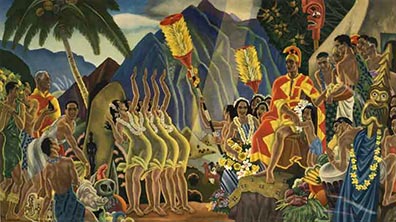
Savage’s market significance rests on his dual legacy as both an institutional authority and a highly collectible commercial artist. His public commissions include monumental murals at Columbia University, Yale University, Purdue University, and the U.S. Court of Appeals in Albany, New York, establishing him as a trusted national arbitrator of taste and visual culture. In 1938, the Matson Navigation Company commissioned him to paint nine extraordinary 4-by-8-foot Hawaiian-themed murals, later adapted into iconic menu covers and promotional lithographs for the SS Lurline cruiseliner—making his Hawaiian imagery among the most recognizable Art Deco travel poster graphics of the Depression and wartime era. His visits to Florida in 1935 and 1953 produced an acclaimed series of Seminole Indian paintings that documented indigenous culture with ethnographic sensitivity during a critical moment in American conservation history. Original Savage Hawaiian menu covers, signed lithographs, and Seminole Indian paintings command premium collector prices; his institutional murals and WPA-era public commissions positioned him as an essential figure in American regionalism, making authenticated prints, archival studies, and signed editions highly sought by collectors of Art Deco travel graphics, American muralism, and 20th-century institutional art.
Showing all 3 results