
Description
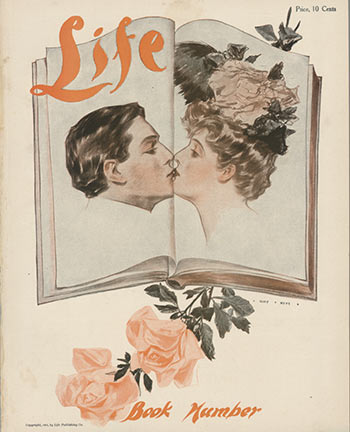
Henry Hutt creates an ingenious visual conceit in this 1905 Life cover—one of his most charming and formally inventive compositions. A man and woman lean toward each other across the open pages of Life magazine itself, their profiles meeting in a tender kiss at the book’s spine. The man occupies the left page; the woman, the right. It’s a clever metaphor: Life magazine brings people together. Romance blooms within its pages.
The execution is impeccable. Hutt renders the couple with remarkable delicacy—the man’s profile strong and masculine, the woman’s softer and more idealized, her hair elaborately coiffed in the Gibson Girl style of the moment. The kiss itself is chaste but unmistakably intimate. Below the open book, a spray of coral roses and green foliage cascades downward, adding romance and visual weight. The composition is perfectly balanced, the color palette restrained—flesh tones, blacks, soft oranges in the roses, the cream of the paper—allowing the central image to command full attention.
There’s an obvious stylistic debt to J.C. Leyendecker, the era’s most celebrated illustrator. Like Leyendecker, Hutt understood how to render beauty with both idealization and psychological truth. But where Leyendecker often emphasized athletic masculinity and sleek modernity, Hutt leans slightly more toward sentiment and romantic grace. Both artists dominated their respective editorial territories; both understood that magazine covers were vehicles for aspiration and fantasy.
The image speaks to the cultural moment of 1905. Romance, courtship, and marriage were central to American popular culture. Magazine covers trafficked in these themes relentlessly—they sold copies. But Hutt’s approach here transcends mere sentimentality. The formal wit of the conceit (the couple as the pages themselves) suggests intellectual sophistication. Life’s readers appreciated clever ideas wrapped in beautiful execution.
The Artist: Henry Hutt (1875–1950)
Henry Hutt was one of the most consistently excellent illustrators of the early twentieth century. Born in Chicago and trained at the Chase School of Art, he brought both technical mastery and genuine artistic sensibility to commercial work. His specialty was figure illustration—particularly fashionable, attractive people in social situations. He contributed prolifically to Life, Collier’s, The Saturday Evening Post, and other major magazines, creating hundreds of covers and interior illustrations over a six-decade career.
What distinguished Hutt was his psychological acuity. His figures weren’t merely pretty; they conveyed personality, emotion, and narrative complexity. Whether depicting social comedy, romance, or drama, Hutt captured the nuances of human interaction with remarkable sensitivity. He was a founding member and later president of the Society of Illustrators, and his work remained relevant and admired throughout his life. He died in 1950, having witnessed the entire evolution of twentieth-century American illustration.
Condition & Details
The poster is in very good condition with warm, well-preserved color and crisp lithographic detail. The image is clean and vibrant, with no significant foxing, creasing, or loss. The paper has aged gracefully, lending the piece authentic period character.
Specifications
- Size: 8.75 × 11 inches
- Medium: Offset lithograph
- Date: 1905
- Publication: Life Magazine
- Artist: Henry Hutt (American, 1875–1950)
- Inventory #: 10783
- Certificate of Authenticity: Included
About Life Magazine in 1905
Life in 1905 was thriving. The magazine had established itself as the premier outlet for sophisticated illustration and commentary on American life. Its covers were eagerly anticipated; the art was first-rate. The magazine’s commercial success rested partly on its ability to publish beautiful, clever images that resonated emotionally with its readers. This Hutt cover exemplifies that formula perfectly—it’s both commercially smart (romance sells) and artistically accomplished.
The Leyendecker Comparison
J.C. Leyendecker was the dominant figure in American illustration during this era, particularly for The Saturday Evening Post. Both Leyendecker and Hutt shared similar training, aesthetic sensibilities, and commercial success. Both specialized in idealized human beauty rendered with technical mastery. Both understood illustration as a form of visual persuasion—creating images that made readers aspire to elegance, sophistication, and romance. Where they differed was in emphasis: Leyendecker leaned toward sleek modernity and athletic vigor; Hutt favored sentiment and psychological subtlety. This cover shows Hutt working in a register closer to Leyendecker’s—the idealization is strong—but with his own gentler, more romantic touch.
Authenticity & Provenance
This is an original vintage poster—not a reproduction. You’re holding an artifact from Life magazine’s golden age, created by one of America’s most talented illustrators at the height of his powers. Original Life covers from 1905 are increasingly scarce; this one has survived in remarkable condition, a testament to careful preservation and the durability of quality offset lithography.



Reviews
There are no reviews yet.