
Description
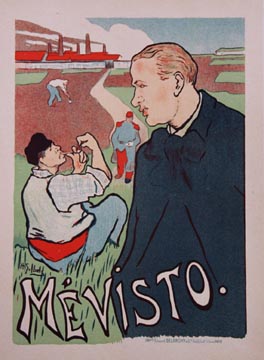
Henri-Gabriel Ibels’s design for “Mevisto” documents Belle Époque entertainment spectacle and performance culture, published as Maître d’Affiche Plate 78 (1897) by Imprimerie Chaix, Paris. Ibels (1867–1936), a close associate of Toulouse-Lautrec and a celebrated poster artist in his own right, brought sophisticated narrative composition and psychological complexity to this advertisement for Mévisto’s performance at the prestigious Concert de la Scala venue. The poster captures a crucial moment of theatrical tension: the magician’s relationship with his young assistant, rendered through gesture, spatial positioning, and chromatic orchestration that transforms a commercial announcement into a psychological drama.
Ibels’s compositional strategy emphasizes performative intimacy and hierarchical power dynamics. The adult magician—rendered in austere dark blue-black silhouette—commands the composition’s upper register, while the young assistant (rendered in warm cream and pale yellow) occupies the lower foreground, gazing upward with expressions alternating between wonder and uncertainty. The spatial recession created by a subtle landscape background (an agricultural field rendered in muted greens and terra cotta) situates the performers within a naturalistic context, distinguishing Ibels’s approach from purely decorative theatre-poster conventions. The typography “MEVISTO” integrates seamlessly with figuration, establishing the performer’s professional identity as a central narrative element.
The Concert de la Scala represented one of Paris’s premier entertainment venues during the Belle Époque. Magic performance—positioned at the intersection of scientific curiosity, theatrical illusion, and entertainment spectacle—attracted diverse urban audiences fascinated by the technological possibilities of modernity. Mevisto’s appearance capitalized on the era’s enchantment with performance innovation and illusionistic mastery. Ibels’s poster transforms advertising into a psychological study: the relationship between performer and assistant becomes a metaphor for control, submission, wonder, and the transformative power of theatrical illusion.
Ibels’s artistic trajectory was shaped by his close association with Toulouse-Lautrec and the Montmartre avant-garde, yet his stylistic approach maintained distinct characteristics: greater compositional restraint, psychological subtlety, and integration of landscape elements absent from Lautrec’s figure-dominant designs. The Plate 78 impression from the Maître d’Affiche run (1895–1900, 256 plates) represents museum-quality documentation of Belle Époque performance culture and poster design mastery. Condition assessment evaluates chromolithographic color integrity, paper support stability, and preservation of the refined blue-black magician silhouette—acid-free archival mounting essential for conservation.



Reviews
There are no reviews yet.