
Description
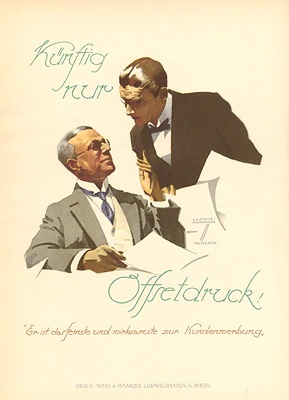
“Künftig nur Offsetdruck!” This phrase means “Future: Offset Printing Only!”
This original Hohlwein ex libris bookplate captures a pivotal moment. Two businessmen shake hands over machinery and blueprints. Their silhouettes are rendered with surgical geometric clarity. Above them, diagonal lines surge upward. They suggest energy and momentum. Below, the formal “EX LIBRIS” banner anchors the composition.
This is more than a functional bookplate. It’s a design manifesto. It’s a historical document celebrating the industrial revolution in printing technology.
Ludwig Hohlwein and the Offset Printing Revolution
Ludwig Hohlwein lived from 1874 to 1949. He was trained as an architect. By 1926, he had mastered tonal contrast. He mastered geometric precision. He mastered typographic authority.
The offset printing revolution changed everything. It promised faster reproduction. It offered sharper impressions. It enabled broader color capability. Traditional lithography required stone and hand-drawn imagery. Offset printing delivered mechanized efficiency without sacrificing artistic integrity.
Hohlwein’s decision to create this authentic vintage Hohlwein offset printing bookplate was philosophical. He was declaring allegiance to the future. He was honoring craft mastery simultaneously.
Compositional Mastery
Two figures dominate the frame. Their high-contrast silhouettes are instantly recognizable. This style made Hohlwein’s posters famous across German markets.
Between them floats a cluster of gears and mechanical diagrams. Nothing feels cluttered. Everything balances against negative space. The gears become almost abstract. They echo Art Deco streamlined modernism.
The slashing parallel lines suggest velocity. They suggest upward momentum. They suggest progress itself.
The Ex Libris Tradition
Ex libris means “from the library of.” It’s an ownership marking through fine art. This tradition flourished during the 1920s. Printing technology had democratized artistic production. Wealthy collectors could commission personal bookplates. These functioned as both practical identifiers and aesthetic statements.
That Hohlwein received such commissions speaks volumes. He understood something important. The bookplate was not subordinate design. It was an opportunity for concentrated artistic excellence. Every inch of this 9″ × 11.75″ surface carries intention.
Lithography and Technical Excellence
The lithographic medium is critical. Hand-drawn lithography enabled tonal gradations. Photomechanical reproduction cannot achieve this. Modern digital offset cannot either.
The subtle half-tones define the businessmen’s faces. The precision of line work describes fabric and machinery. The crisp letterpress clarity appears in the “EX LIBRIS” text. All reflect Hohlwein’s technical virtuosity. All reflect the printer’s expertise in registration and pressure control.
This is not a reproduction poster. This is an original impression from the lithographic process.
Condition and Preservation
Condition is Grade A throughout. Impressions are sharp. Margins are pristine. The paper displays warm cream toning. This is characteristic of period German lithographs stored in optimal conditions.
The paper remains unbacked original stock. This is rare in vintage poster preservation. It offers future collectors restoration flexibility. Conservation options remain open if aging warrants intervention.
For the Collector
Collectors seeking original posters for sale know this: authenticity matters. Investment value matters. Historical significance matters.
This offset printing bookplate represents all three. It sits at the intersection of design history, industrial optimism, and authenticated mastery of Hohlwein. It documents the moment when modernism and machine production became synonymous with artistic progress. That conviction defined the 1920s avant-garde across Europe.




Reviews
There are no reviews yet.