
Description
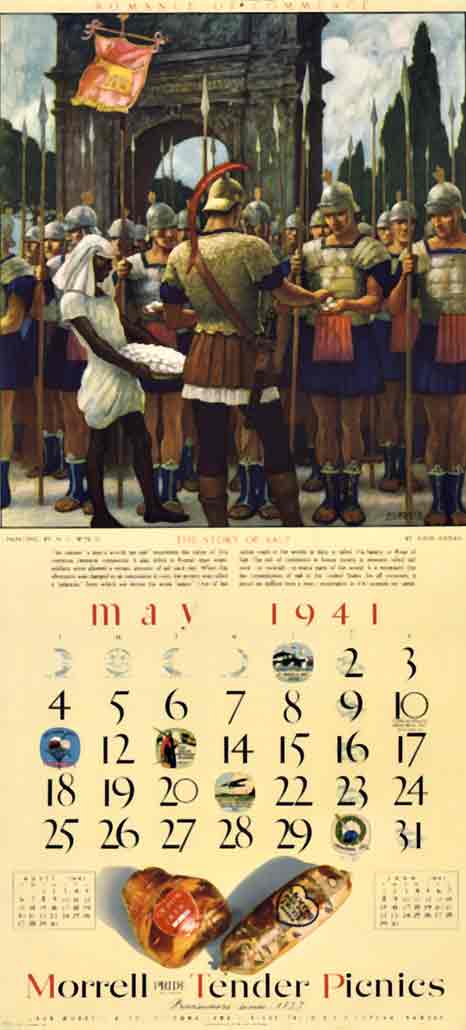
Jose Morell painted “Story of Salt” in 1941, and the Morrell Company knew exactly what they were doing when they chose this image for their calendar that year—it’s a moment of quiet responsibility, soldiers lined up receiving their salt rations, a scene that felt urgent and meaningful during wartime. The composition draws you in immediately: the careful attention to uniform detail, the formal dignity of the military hierarchy, the way Morell captures the human moment within institutional order. This wasn’t just calendar filler; it was propaganda art that celebrated essential work and sacrifice, wrapped in the guise of a practical desk calendar.
The lithography here carries Morell’s signature style—architectural precision in the figures, rich earth tones and military blues that ground the scene in reality rather than romance. You can see his hand in every detail: the folds of those uniforms, the careful rendering of faces, the compositional balance that makes a utilitarian moment feel almost ceremonial. The 16″ x 11″ format gave him real canvas to work with, and he used every inch to create something that feels both historical document and fine art. The color separation work is sharp and intentional, with no muddy zones or bleeding—this is premium lithography work by someone who understood the medium deeply.
This calendar represents a specific moment in American manufacturing history when companies understood that their advertising could do double duty: promote the brand while contributing to the national conversation happening that year. Morrell was a meat company, but by sponsoring Morell’s historical narrative about salt and military provisioning, they positioned themselves as part of something larger than commerce. Today, that makes this piece a genuine artifact of 1941 American consciousness—what stories did companies think mattered to tell?
The condition is solid across the board—the calendar grid is intact, the illustration shows rich color retention with no fading across the military blues or flesh tones. There’s no staining, no major creasing, and the paper has aged gracefully. This piece has been stored with care, which speaks to whoever owned it before, and to an understanding of its value as both advertising ephemera and fine art. It’s ready to be displayed or framed without hesitation.
This is the kind of vintage calendar that reminds you why collectors hunt for these things—it’s not nostalgia, it’s holding a direct line to what a company chose to say about itself in a year that mattered, painted by an artist who understood how to make meaning out of ordinary moments.




Reviews
There are no reviews yet.